
Sampling perfume might sound simple, just spritz and sniff. But the reality is much deeper. A fragrance can change dramatically as it interacts with your skin’s unique chemistry, revealing hidden notes and unexpected depth that no strip of paper ever captures. Most people think they can pick a signature scent in minutes at the shop counter. The real secret is that the perfect fragrance is uncovered through patience, careful testing, and understanding the subtle journey a scent takes on your own body.
Table of Contents
- Step 1: Select The Right Perfume Samples To Start
- Step 2: Prepare Your Skin For Fragrance Application
- Step 3: Apply Perfume Samples Carefully For Best Results
- Step 4: Test The Fragrance Throughout The Day
- Step 5: Evaluate Your Experience And Make Decisions
Quick Summary
| Key Point | Explanation |
|---|---|
| 1. Choose diverse perfume samples | Explore various fragrance families to find scents that resonate with your personal style and body chemistry. |
| 2. Prepare skin properly before application | Clean and moisturise pulse points to enhance fragrance longevity and performance on your skin. |
| 3. Apply perfumes with care | Use restraint in application to allow the fragrance to develop and activate naturally without excessive rubbing. |
| 4. Test scents throughout the day | Document how perfumes evolve over time to gain insights on their longevity and character in different conditions. |
| 5. Evaluate experiences thoughtfully | Reflect on emotional responses and versatility to identify fragrances that authentically represent your identity. |
Step 1: Select the Right Perfume Samples to Start
Choosing the perfect perfume samples is the foundation of creating a personalised scent experience. The process requires understanding your personal preferences, exploring fragrance families, and strategically testing different compositions. Your goal is to discover scents that harmonise with your unique body chemistry and reflect your individual style.
Begin by considering the fragrance families that intrigue you most. Perfume samples typically fall into several key categories: floral, woody, oriental, fresh, and gourmand. Each family offers distinct characteristics that appeal to different sensory preferences. For instance, floral fragrances tend to be light and romantic, while woody scents provide deeper, more complex undertones. By sampling across these categories, you’ll develop a nuanced understanding of what truly resonates with your olfactory senses.
When selecting perfume samples, prioritise variety and quality. Explore our designer-inspired sample collections that offer affordable opportunities to experiment with multiple scent profiles. Look for sample sets that include diverse fragrance families, allowing you to test how different compositions interact with your skin’s natural chemistry. Pro tip: Always test perfume samples directly on your skin, not just on paper strips. Your body heat and unique biochemistry will reveal how a fragrance truly performs and transforms throughout the day.
Consider your lifestyle and the occasions where you’ll wear these fragrances. Are you seeking a professional workplace scent, an evening statement fragrance, or a casual everyday perfume? Different environments and social contexts call for nuanced fragrance selections. Some samples might work brilliantly in cooler seasons, while others shine during warmer months. Pay attention to how each sample evolves over several hours, noting top notes, heart notes, and base notes to understand the fragrance’s complete olfactory journey.
Use this comparison table to quickly understand the distinctive characteristics of each main fragrance family mentioned, helping to match scent types to personal preferences and situations.
| Fragrance Family | Characteristics | Typical Appeal |
|---|---|---|
| Floral | Light, romantic, often featuring rose, jasmine or lily notes | Feminine, soft, suitable for daytime |
| Woody | Deep, earthy, complex undertones such as sandalwood or cedar | Sophisticated, warm, good for evening |
| Oriental | Warm, spicy, sometimes with amber or vanilla | Sensual, bold, ideal for special occasions |
| Fresh | Clean, citrusy, sometimes green or aquatic notes | Energetic, refreshing, perfect for daily wear |
| Gourmand | Sweet, edible notes like vanilla, caramel or chocolate | Playful, comforting, distinct in cooler weather |
Finally, trust your instincts and be patient with the sampling process. Not every perfume will be an instant match, and that’s perfectly normal. Keep a small notebook or digital record of your sample experiences, noting your impressions, emotional responses, and how long each fragrance lasted. This methodical approach transforms perfume sampling from a random experiment into a personalised sensory exploration, ultimately guiding you towards scents that feel authentically and wonderfully you.
Below is an overview table summarising each main step in the perfume sampling process, including its focus and key outcome for readers who want a concise yet comprehensive guide.
| Step | Focus | Key Outcome |
|---|---|---|
| 1 | Selecting diverse perfume samples | Discover scents that suit personal style and body chemistry |
| 2 | Preparing skin for fragrance application | Optimise longevity and true scent development on your skin |
| 3 | Careful perfume sample application | Ensure accurate testing and natural fragrance activation |
| 4 | Testing fragrance throughout the day | Observe scent evolution and performance in real circumstances |
| 5 | Evaluating experience and making decisions | Identify fragrances that best match your identity and preferences |
Step 2: Prepare Your Skin for Fragrance Application
Preparing your skin for perfume application is a crucial step that significantly impacts fragrance performance and longevity. The right preparation transforms a simple scent application into an art form, ensuring that your chosen perfume sample interacts perfectly with your unique skin chemistry. Think of your skin as a canvas, and the fragrance as a delicate painting that requires a clean, smooth surface to truly shine.
Start by thoroughly cleansing your skin with a mild, unscented soap or body wash. Avoid using heavily fragranced products that might interfere with your perfume sample’s true scent profile. Focus on areas where you plan to apply the fragrance, typically pulse points like the wrists, neck, behind the ears, and inner elbows. These locations generate warmth, which helps to activate and diffuse the fragrance throughout the day. Ensure your skin is completely dry and free from other skincare products that could alter the perfume’s natural development.
Learn more about maximizing your fragrance experience by understanding how skin preparation impacts scent projection. Hydration plays a critical role in fragrance performance. Apply an unscented moisturiser to your pulse points about 10 minutes before spraying your perfume sample. This creates a subtle protective layer that helps the fragrance adhere better and last longer. Dry skin tends to absorb and dissipate scents more quickly, while well-moisturised skin allows the fragrance to develop its full aromatic potential.
Pay special attention to your skin’s unique characteristics. If you have sensitive skin, perform a small patch test with the perfume sample on your inner forearm. Wait 24 hours to check for any adverse reactions. Some individuals might experience slight irritation or allergic responses to certain fragrance ingredients. By taking this precautionary step, you protect yourself while ensuring a comfortable and enjoyable fragrance experience.
Remember that your skin’s condition can dramatically influence fragrance performance. Factors like diet, hydration, body temperature, and even stress levels can subtly alter how a perfume develops and smells. Approach your perfume sampling journey with patience and curiosity. Each application is an opportunity to discover how different scents interact with your personal biochemistry, creating a truly unique olfactory experience that is entirely your own.
Step 3: Apply Perfume Samples Carefully for Best Results
Applying perfume samples requires precision, technique, and an understanding of how fragrances interact with your skin. The goal is to experience the full depth and complexity of each scent while preserving its unique character. This step transforms your perfume sampling from a casual experiment into a deliberate sensory exploration.
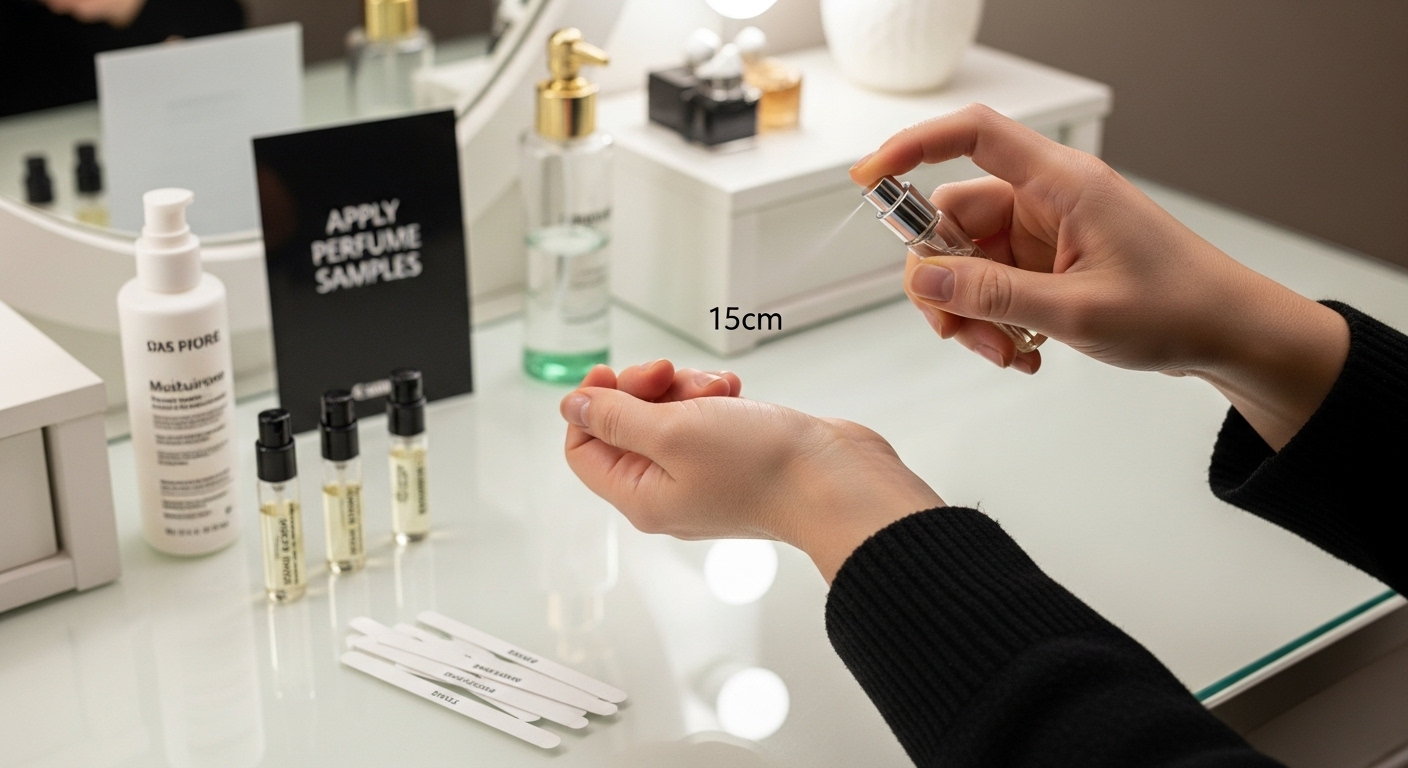
Begin by holding the perfume sample approximately 10-15 centimetres away from your chosen pulse points. Pulse points are strategic locations where body heat naturally helps to diffuse and amplify fragrance. These include the inner wrists, base of the throat, behind the ears, inside the elbows, and even behind the knees. Spray or dab the sample gently, using no more than one or two light applications. Restraint is key; you can always add more, but removing excess fragrance is challenging.
Discover more about perfume application techniques that professionals use to maximize fragrance performance. Avoid rubbing the perfume into your skin, which might seem intuitive but actually damages the molecular structure of the fragrance. Instead, allow the perfume to settle naturally, letting your body heat activate its complex scent profile. Think of this as allowing the fragrance to breathe and unfold organically.
Consider the time of day and your planned activities when applying perfume samples. Fragrances perform differently depending on environmental conditions and personal body chemistry. Morning applications might reveal different notes compared to evening wear. Pay attention to how the scent transforms over several hours, noting its evolution from initial top notes through heart notes and into base notes. Some fragrances might surprise you, revealing unexpected depth or subtlety as they interact with your unique biochemistry.
Document your sampling experience meticulously. Keep a small notebook or digital journal where you record each perfume sample’s initial impression, how it develops throughout the day, and your emotional response. Note factors like longevity, projection, and how the fragrance makes you feel. This systematic approach turns perfume sampling into a personal journey of olfactory discovery, helping you understand not just the technical aspects of fragrances, but their profound ability to evoke memories, emotions, and personal identity. Remember, the perfect perfume is not just about smelling good, but about feeling authentically and wonderfully yourself.
Step 4: Test the Fragrance Throughout the Day
Testing a perfume sample is an immersive journey that reveals the true character of a fragrance beyond its initial application. The real magic of a scent unfolds over hours, not minutes, transforming your understanding of how a perfume interacts with your unique body chemistry and daily environment. This step is about patience, observation, and developing a nuanced appreciation for olfactory complexity.
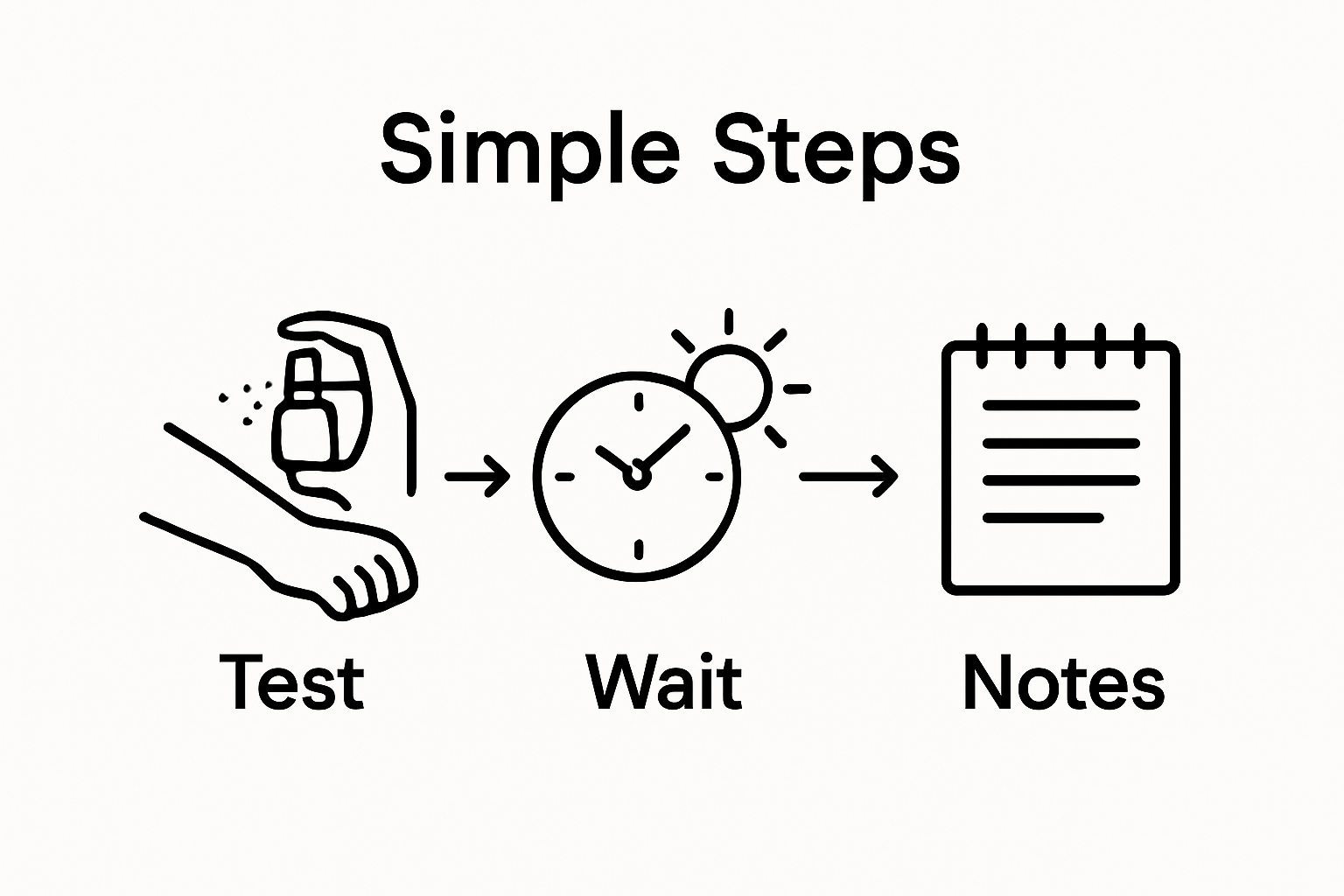
Begin your fragrance exploration by documenting your initial impressions immediately after application. Note the initial burst of top notes, which typically reveal themselves within the first 15-30 minutes. Pay attention to how the scent changes as you move through different environments and activities. Workplace air conditioning, outdoor temperature, physical movement, and even your emotional state can subtly alter a fragrance’s projection and character. Keep a small notebook or digital journal to track these fascinating transformations.
Explore the art of perfume composition to understand the intricate layers that contribute to a fragrance’s evolution. As the day progresses, observe how the perfume transitions through its middle (heart) notes and eventually settles into its base notes. These final notes typically emerge 4-6 hours after initial application and represent the fragrance’s most intimate and personal expression. Some scents might surprise you, revealing unexpected depth or subtlety that was not apparent during the first application.
Consider the practical aspects of fragrance performance during your daily routine. Test how long the scent remains detectable, its projection (how far the fragrance travels from your skin), and whether it feels appropriate for different settings. A perfume that feels perfect during a morning meeting might feel too intense during an evening social event.
 Pay attention to potential interactions with other personal care products, such as body lotions or deodorants, which can sometimes alter a fragrance’s intended profile.
By the end of your testing day, you’ll have gathered invaluable insights into the perfume’s true personality. Evaluate the fragrance based on multiple criteria: longevity, how it makes you feel, its versatility across different environments, and most importantly, whether it resonates with your personal identity. Remember that selecting a signature scent is an intimate process. What works magnificently for one person might feel completely different on another. Trust your instincts, embrace the exploration, and enjoy discovering the subtle nuances that make each fragrance a unique sensory experience.
Step 5: Evaluate Your Experience and Make Decisions
Evaluating your perfume sample experience is the culmination of your sensory journey, transforming personal observations into a meaningful selection process. This final step is about synthesizing your insights, understanding your emotional connection with different fragrances, and making an informed decision that reflects your unique personality. Think of this evaluation as a personal fragrance dialogue, where you’re both the researcher and the subject.
Review the comprehensive notes you’ve collected throughout your sampling process. Your documentation should include detailed observations about each fragrance’s performance, including how it developed over time, its longevity, projection, and most importantly, how it made you feel. Look beyond technical characteristics and focus on the emotional resonance of each scent. A truly perfect fragrance does more than smell pleasant it evokes memories, boosts confidence, and becomes an extension of your personal narrative.
Learn more about personalising your fragrance journey and understanding the nuanced world of scent selection. Evaluate each perfume sample across multiple critical dimensions. Consider its versatility across different settings like professional environments, social gatherings, and intimate moments. Assess how the fragrance interacts with your natural body chemistry, noting whether it becomes more appealing or loses its charm as hours pass. Pay attention to unsolicited comments from friends or colleagues these external perspectives can provide valuable insights you might have overlooked.
Narrow down your selections by creating a ranking system that goes beyond simple likes and dislikes. Develop a scoring method that considers factors such as emotional impact, versatility, longevity, and uniqueness. Your top contenders should not just smell good, but should feel like a natural extension of your personality. Some fragrances might be technically perfect but lack the intangible quality that makes a scent truly yours. Trust your intuition and be willing to explore unexpected combinations.
Finally, recognize that perfume sampling is an ongoing journey of self-discovery. The fragrance that captivates you today might evolve as your personal style and life circumstances change. Remain open to periodic re-evaluation, allowing your olfactory preferences to grow and transform. Your signature scent is not just a product you wear it’s a personal statement, a invisible accessory that communicates your essence to the world. Embrace the process, celebrate your unique sensory exploration, and enjoy the intimate art of finding fragrances that genuinely represent you.
Turn Your Perfume Sampling into a Signature Scent Experience
Are you tired of endless guesswork when choosing new fragrances? If you have ever struggled to find scents that truly reflect your personality or worried about making costly mistakes, you are not alone. Many readers in the article discovered that selecting the right perfume samples, preparing their skin properly, and testing each fragrance throughout the day are all essential steps to achieve a unique, personal scent. At Barcode Fragrances, we solve the problem of uninspiring, generic perfumes by offering high-quality samples inspired by designer favourites. Each sample empowers you to find fragrances that suit your distinctive style and body chemistry—without breaking the bank. Our premium oils and curated collections ensure you experience depth, longevity, and luxury at every step of your journey.
Ready to discover your scent identity? Browse our collections to start your personalised sampling journey, or dive into our full range at Barcode Fragrances. Don’t settle for average—explore, test, and find the designer-inspired fragrances that make you feel confident every day. Shop now and create your signature blend while our latest sample offers last.
Frequently Asked Questions
How can I choose the right perfume samples for my preferences?
Choosing the right perfume samples involves understanding fragrance families such as floral, woody, oriental, fresh, and gourmand. Start by exploring these categories and prioritising variety, ensuring you select samples that will interact well with your unique body chemistry.
What are pulse points and why should I apply perfume there?
Pulse points are areas on your body where blood vessels are closest to the skin, generating warmth. Applying perfume to these areas, such as your wrists and neck, helps activate the scent and allows it to diffuse more effectively throughout the day.
How should I prepare my skin before applying perfume?
To prepare your skin for fragrance application, start by cleansing with an unscented soap and ensuring your skin is dry. Applying an unscented moisturiser to pulse points before spraying the perfume can help the scent adhere better and last longer.
How should I evaluate the performance of a perfume throughout the day?
To evaluate a perfume’s performance, track its top notes after initial application and observe how it changes over hours. Note its longevity, projection, and any environmental factors that may influence its scent to better understand how it suits your preferences.